With Exotic Anosov Flows, Researchers Disprove the Venerable Verjovsky Conjecture
SLMath - June 2026
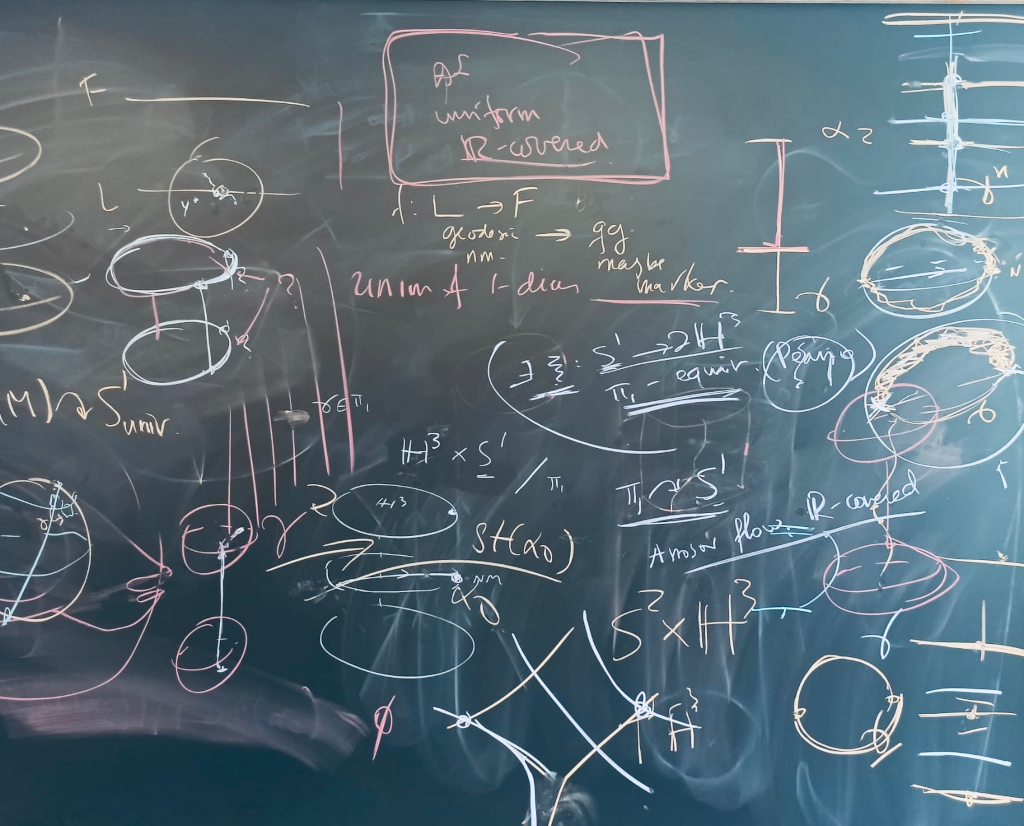
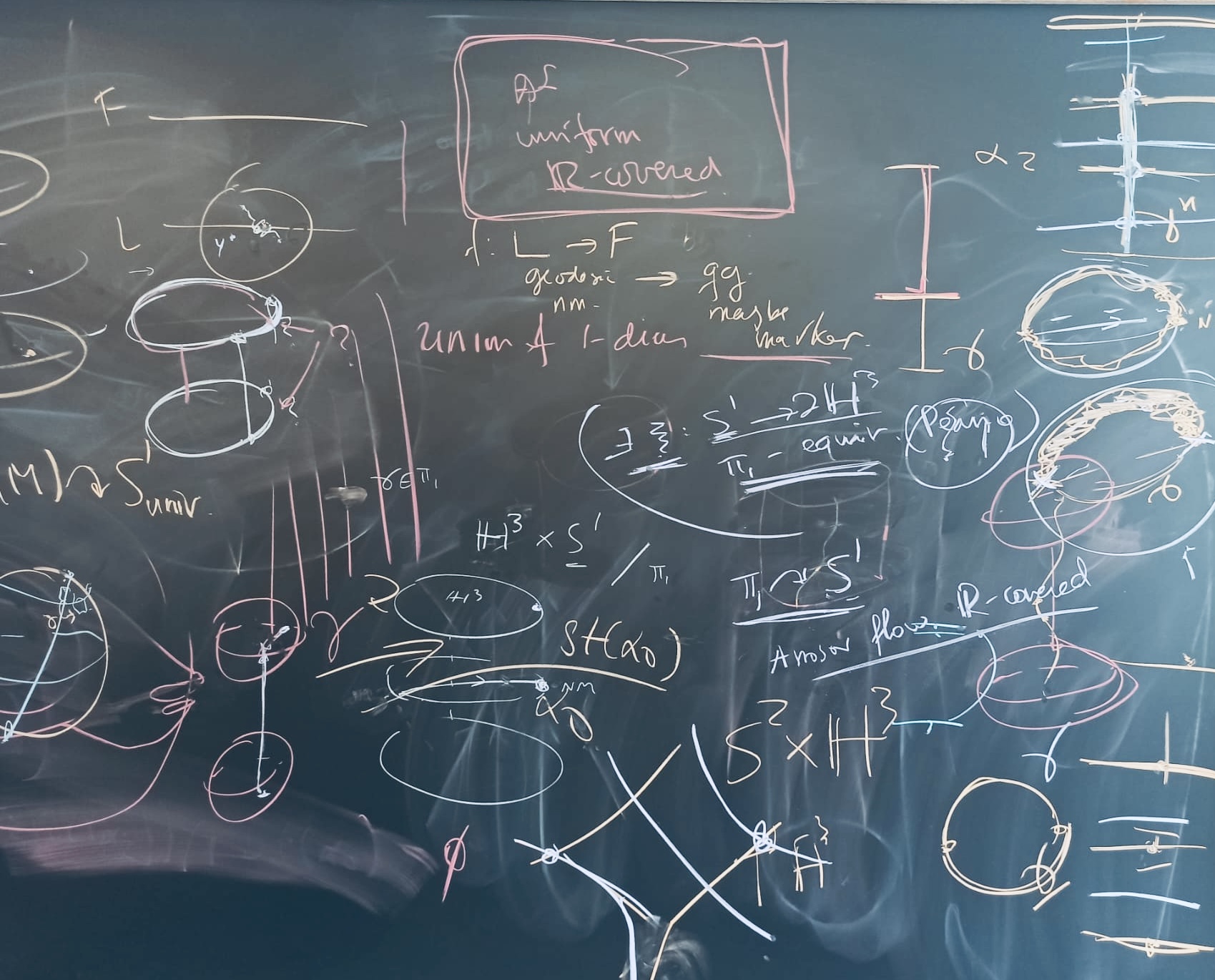
topol-2026-chalkboard.jpg504.66 KBThe chalkboard recording a key conversation that led to the “Exotic Codimension One Anosov Flows” breakthrough (with a paper of that title in the works) by Sergio Fenley, Kathryn Mann and Rafael Potrie, during the Spring 2026 SLMath program on Topological and Geometric Structures in Low Dimensions. Photo courtesy of Sergio Fenley.
For fifty years, the Verjovsky conjecture held, and mathematicians believed, that a certain chaotic-yet-stable dynamical system — a certain type of Anosov flow, a mathematical model of a complex physical system such as the weather — could not exist in dimensions higher than three.
But in a burst of six weeks this spring — during the program on Topological and Geometric Structures in Low Dimensions at the Simons Laufer Mathematical Sciences Institute in Berkeley, with support from the U.S. National Science Foundation — three researchers surprised even themselves when they unexpectedly proved the conjecture wrong.
“We started out trying to prove the conjecture, convinced it was true, and then the evidence started pointing the other way,” said mathematician Kathryn Mann, of Cornell University and CNRS. “It was both shocking and exhilarating.”
Dr. Mann’s collaborators in this achievement are Sergio Fenley of Florida State University and Rafael Potrie of Center for Mathematics at the University of the Republic, Uruguay. The SLMath program was the first time these three mathematicians had been in the same place for more than a week.
Initially, their breakthrough came into view gradually here and there, with conversations after seminars, over coffee, at chalkboards. And then, once they bumped into a weird counterexample to the conjecture, progress proceeded apace.
Dr. Fenley recalled: “We dropped everything. We said, ‘Okay, for as long as it takes until the end of the semester, we just need to get this done.’”
Within about forty days — including many late-night WhatsApp messages — the team had discovered not just one four-dimensional counterexample to the Verjovsky conjecture, but infinitely many.
By the end of the semester, the researchers had presented their results to SLMath program participants in two in-depth seminar talks. They had also drafted a 20-page paper — “Exotic Codimension One Anosov Flows” — circulated it to some 20 experts for feedback, and released it on the arXiv.
“This is by far the fastest and most intensely I’ve ever worked on a project,” Dr. Mann said. “To suddenly realize not only that the conjectured picture is wrong, but that there is an entire new family of flows sitting there in dimension four, is incredibly exciting. It feels like we’ve opened a door onto a whole new corner of the landscape that we didn’t even know existed.”
A proof by contradiction
This research began at SLMath when Dr. Fenley, Dr. Mann and Dr. Potrie got stuck on another, unrelated problem. Seeking a distraction, they turned their attention elsewhere — circling back to the Verjovsky conjecture, which they’d each previously contemplated to various extents.
A formal program to classify and describe all possible examples of Anosov flows began in the 1960s. By the 1980s, it was clear that there were lots of examples of such flows in three dimensions, but almost none in higher dimensions. Circa 1970 this paucity motivated the conjecture by Alberto Verjovsky, which, in technical terms, ventured that: Every codimension-one Anosov flow on a manifold of dimension greater than three is topologically equivalent to the suspension of a hyperbolic toral automorphism.
On a number of occasions, the conjecture looked to be true with promising nearly-there results (some still under review). But there were always caveats — with, for instance, a proof that was contingent on an extra hypothesis; or a proof that involved an irresolvable gap.
In trying to prove the conjecture true, the SLMath team pursued a proof by contradiction: a classic mathematical strategy whereby one proves a statement is true by demonstrating the impossibility of an example indicating that it is false.
“Suppose a counterexample existed,” said Dr. Mann. In this case, the counterexample would consist of another type of Anosov flow in, say, dimension four. That is, it would be a flow structure that was not topologically equivalent to the suspension of a hyperbolic toral automorphism. “It would have to look unbelievably weird—so weird it probably can’t exist.”
Having conjured such an implausible configuration for a counterexample, then came the twist. While attending program seminars, the researchers kept seeing a similarly weird structure: the Cannon–Thurston map.
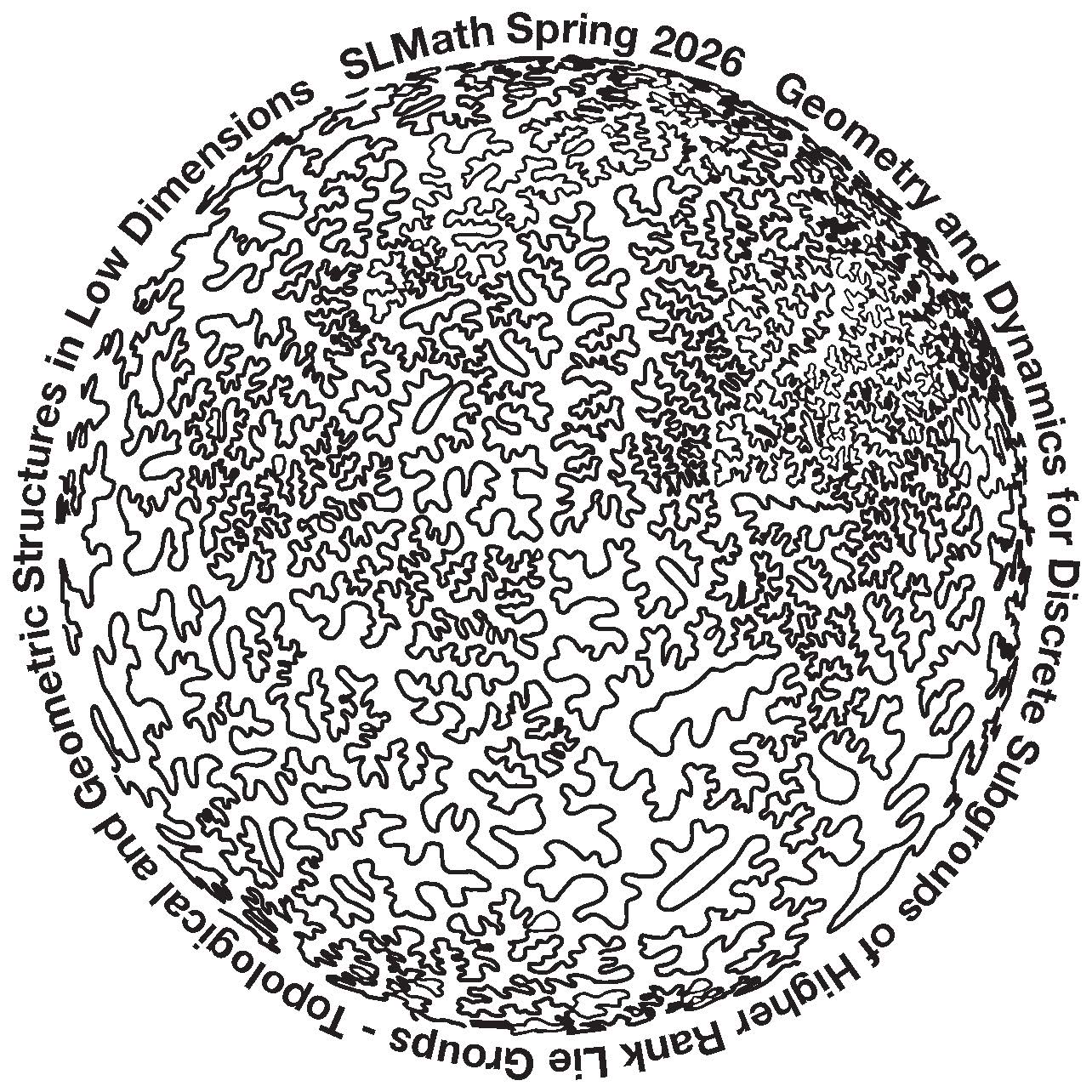
The Cannon–Thurston map is a continuous map from the circle into a sphere; the circle fills the sphere in a wild space-filling loop that displays a significant amount of symmetry. The map was a recurring character that popped in different places during the semester — in both the “Topological and Geometric Structures in Low Dimensions” program, and the complementary program on “Geometry and Dynamics for Discrete Subgroups of Higher Rank Lie Groups” — and came to decorate the semester’s official T-shirts.
art-2-Cannon-Thurston-map.jpg436.31 KBThe Cannon–Thurston map, as depicted on the T-shirt for the Spring 2026 semester at SLMath; designed by Michael Landry co-organized with Saul Schleimer. The image of the Cannon–Thurston map is from the recent preprint “CaTherine Wheels” by Danny Calegari and Ino Loukidou. Image courtesy of Michael Landry.
Cannon–Thurston maps originally arose in 3‑manifold topology. They had been studied by researchers in geometric topology; but not in dynamics, the field where the Verjovsky conjecture comes from. But, as it turned out, Anosov flows in four dimensions effectively embed such a map into a system’s dynamics.
A key ingredient of the proof — what really made it work — was the construction’s so-called “codimension-one” property. Dr. Potrie explained: “If all directions but one are contracting, which is the codimension-one property, then it is easier to show that the remaining direction has to expand under some mild assumptions. This helps a lot in the proof.”
An unexpected application
After the fact, the researchers realized there was also an unintended secondary result: The proof construction provided answers to unrelated questions about Cannon–Thurston maps.
“This family of maps give a way to cover a sphere with a very long circle that winds around so much that it covers every point on the sphere,” Dr. Mann said. “A question you can ask is: ‘How much does the circle have to cross itself in order to do this?’”
“What we prove is that any map with these properties — a particular kind of circle-covering of a sphere that respects some symmetry — we prove and show abstractly that anything with these properties doesn't cross the same point infinitely often. Any point is covered at most k times; or say at most five times. This was really unexpected.”
“The theorem, the four-dimensional picture and the analysis implies something about the original map which was not known before,” Dr. Potrie said.
Dr. Fenley added, “It’s like a cherry on top.” And it is a concrete application of this breakthrough result, which has already been cited by a program participant, Ellis Buckminster of the University of Pennsylvania, in a paper on Cannon–Thurston maps.
“These new four‑dimensional examples are not just curiosities,” Dr. Mann said. “We made infinitely many Anosov flows on different manifolds. Now there is a theory with a 10-year research program. There are new objects in math we didn't know existed. We can study them, try to understand what these flows are, and how far this new picture can go.”